Our group’s highlights at IEEE ECCE 2026.
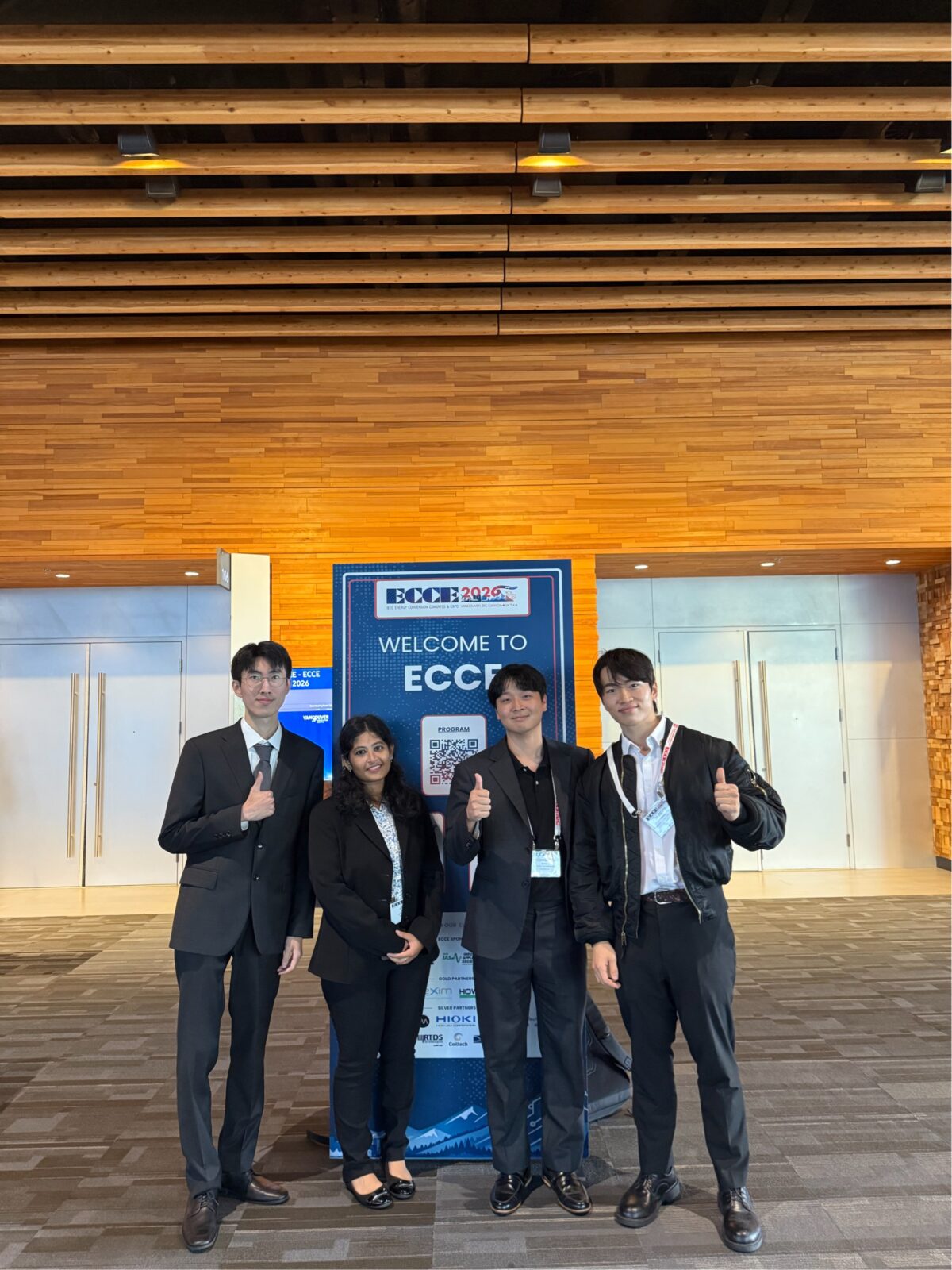
Our group presented seven research contributions, including two oral presentations and five posters, at the 2026 IEEE Energy Conversion Congress and Exposition (ECCE). Together, these studies reflect the breadth of our work in power electronics, spanning converter control, physics-informed machine learning, pulsed power, magnetic component design, and thermal packaging.
A common thread across these topics is the need to design power electronic systems around the physical conditions in which they operate. Converter dynamics, electromagnetic interference, component mismatches, and thermal constraints all shape system behavior. The work presented at ECCE examines these challenges from complementary perspectives, connecting control and modeling with the design of components and hardware.
Converter Control and Physics-Informed Learning
Our two oral presentations explored different approaches to understanding and controlling power converters.
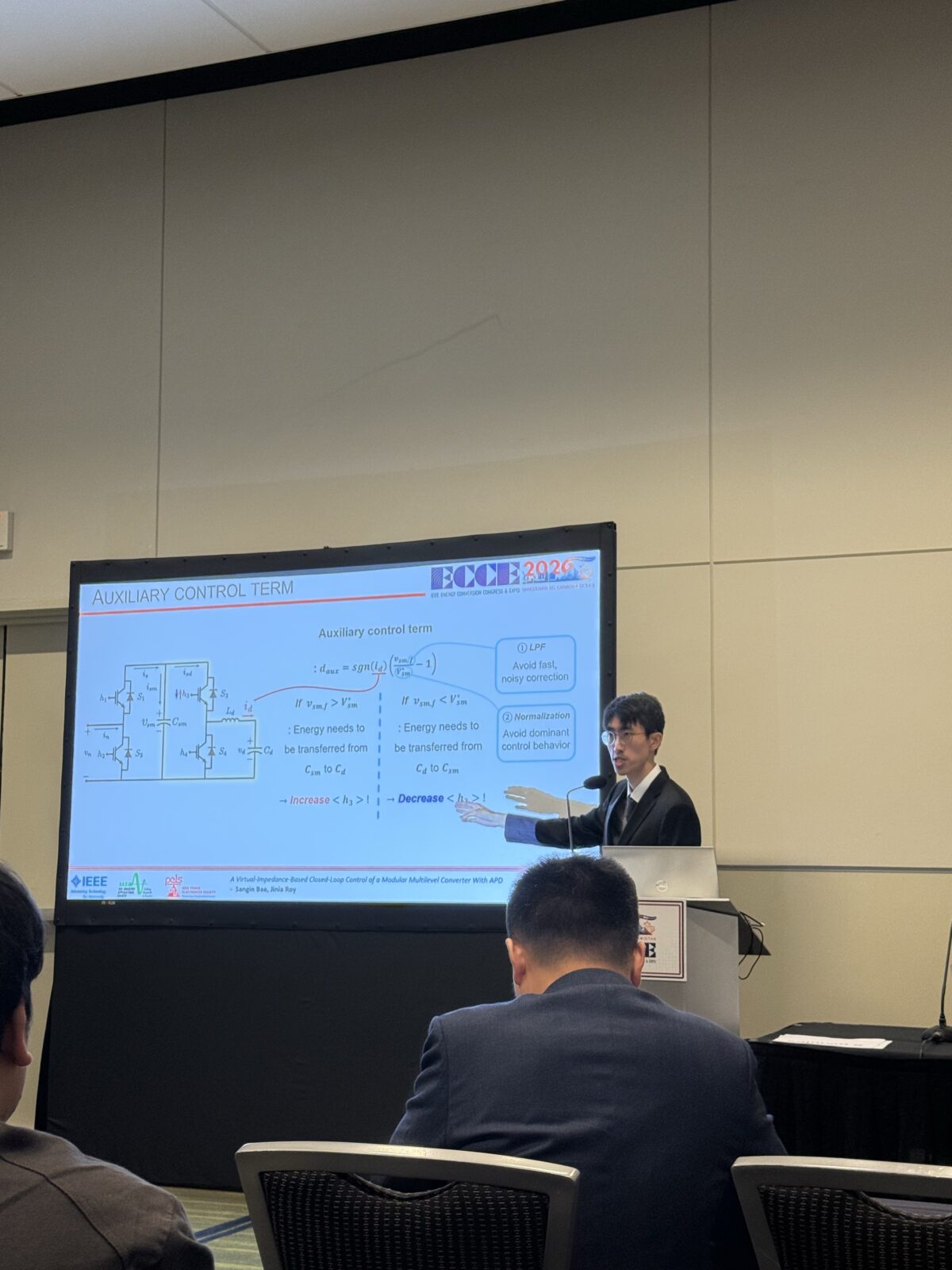
“A Virtual-Impedance-Based Closed-Loop Control of Modular Multilevel Converter with Active Power Decoupling,” by Sangin Bae and Jinia Roy, investigated virtual impedance as a basis for closed-loop control in a modular multilevel converter with active power decoupling. The study brings together converter regulation and power-decoupling dynamics, addressing their interaction within a modular conversion system.
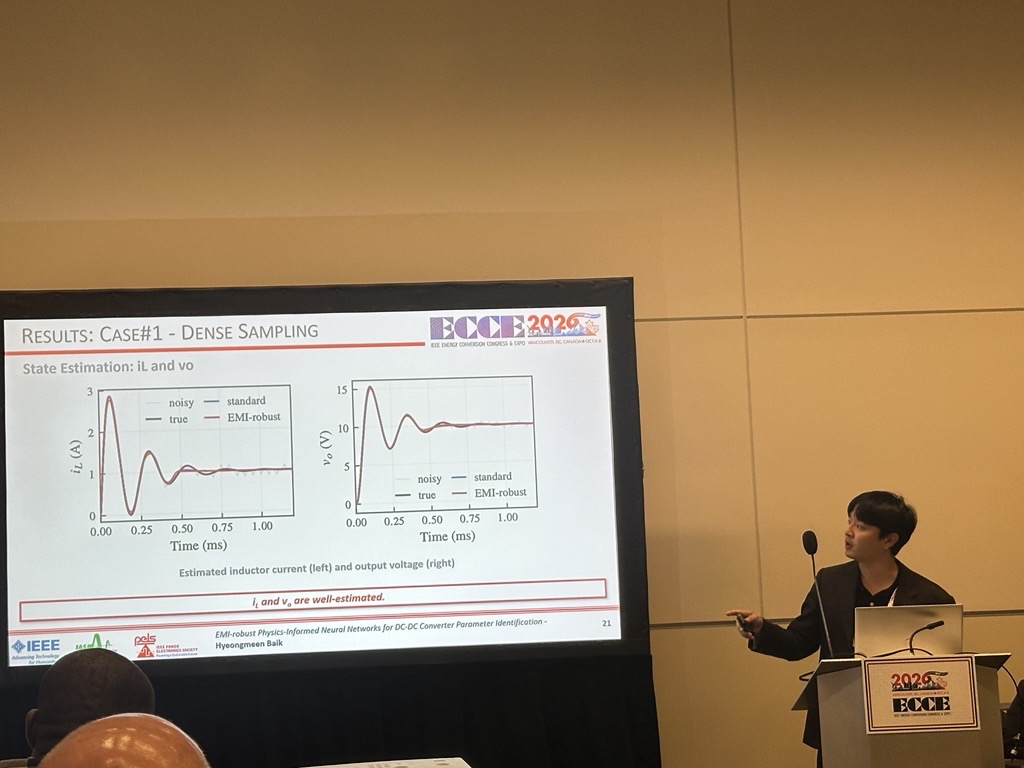
“EMI-Robust Physics-Informed Neural Networks for DC-DC Converter Parameter Identification,” by Hyeongmeen Baik, Hamed Poursiami, Maryam Parsa, and Jinia Roy, explored how physical models can inform learning-based parameter identification in the presence of electromagnetic interference. Identifying converter parameters from measured data requires accounting for the conditions that affect those measurements. This work connects physics-informed learning with that practical challenge.
Modeling and Control for Pulsed Power Systems
Three poster presentations addressed pulsed power applications, where energy must be delivered under demanding timing, charging, and load conditions.
“A Multi-Port LCL-T Resonant Converter-Voltage Controlled Current Source for Capacitor Charging in Impedance-Matched Solid-State Marx Generators,” by Pourya Javidi, Abhinav Chinnusamy, and Jinia Roy, examined a resonant converter approach to capacitor charging. The work focuses on the charging stage that supports pulse generation, linking converter operation with the requirements of a multi-stage pulsed power system.
Complementing this converter-level study, “Sensitivity Analysis of Impedance and Inter-Stage Delay Mismatches in Impedance-Matched Solid-State Marx Generators,” by Abhinav Chinnusamy, Pourya Javidi, and Jinia Roy, examined how departures from matched operating conditions affect system behavior. Studying impedance and timing mismatches helps connect an ideal system design with the variations encountered in implementation.
“Modeling and Dual-Mode Control of a Pulsed Buck Flashlamp Driver,” by Hyeongmeen Baik, Sangin Bae, Daniel Hartog, and Jinia Roy, addressed the modeling and control of a converter driving a flashlamp load. The study considers how a dual-mode control approach can accommodate distinct operating requirements within the pulsed driver.
Together, these contributions examine pulsed power systems at several levels: capacitor charging, coordination between stages, and control of the converter-load interface.
Magnetics and Thermal Packaging
Two additional posters focused on the physical components and packaging that define the practical limits of power electronic systems.
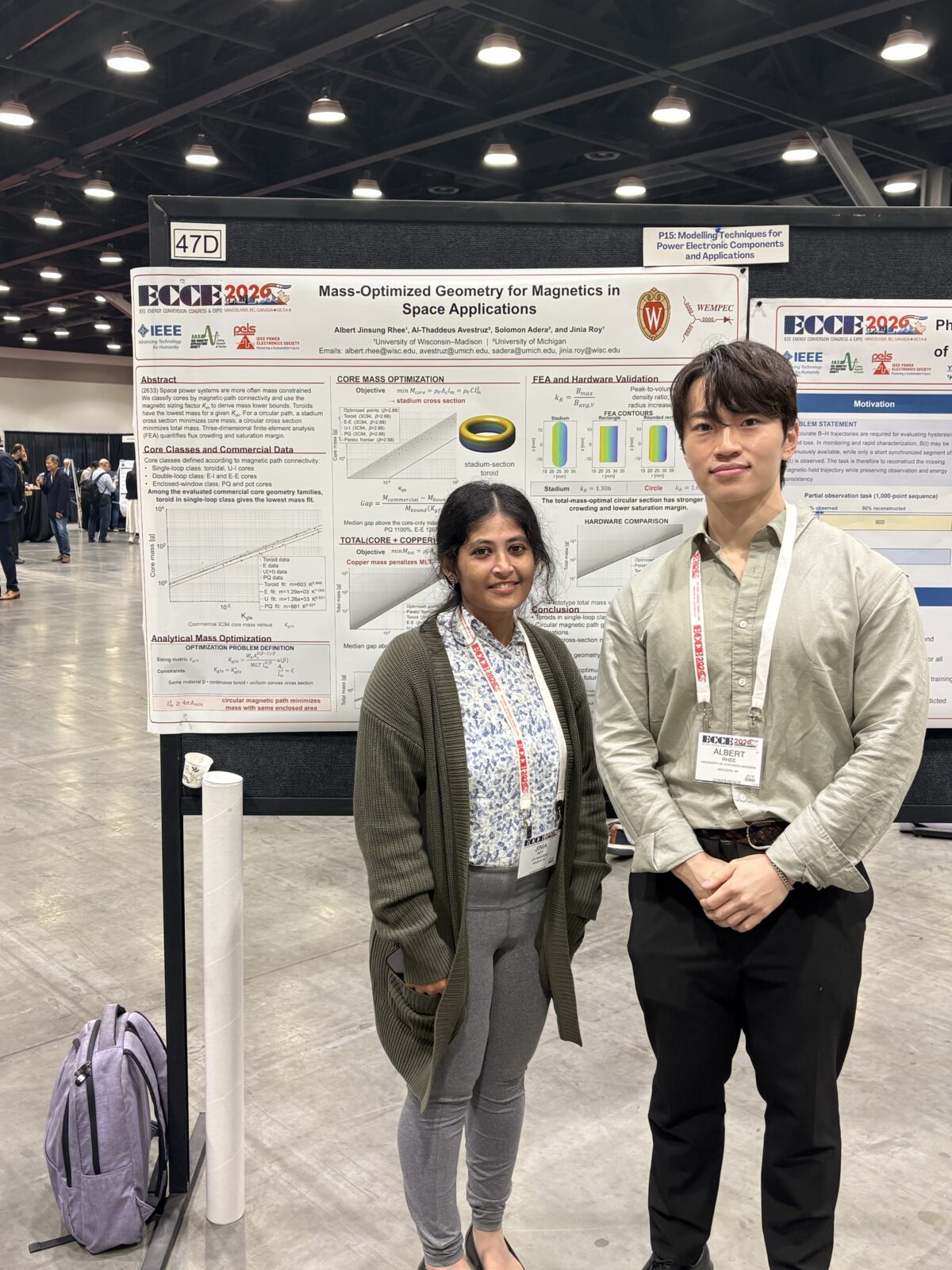
“Mass-Optimized Geometry for Magnetics in Space Applications,” by Albert Rhee, Al-Thaddeus Avestruz, Solomon Adera, and Jinia Roy, examined magnetic component geometry with mass as a central design objective. In space applications, component design must account for the cost of carrying mass alongside electrical requirements. This work places that constraint directly within the magnetics design problem.
“Two-Sided Power Electronics on Ceramics Enabled by New ‘Picture Frame’ Cooling,” by Takiyah Ali, Saachvir Singh, Pawelski, Jinia Roy, Al-Thaddeus Avestruz, and Solomon Adera, explored a cooling and packaging approach for two-sided power electronics on ceramic substrates. The study connects thermal management with the physical arrangement of power electronic hardware, examining how cooling structures can enable new packaging configurations.
These contributions extend the group’s research beyond circuit operation to the magnetic, structural, and thermal decisions that influence how power converters can be built.
Across all seven presentations, ECCE provided an opportunity to share our work and discuss its implications with the power electronics community. Congratulations to our presenters and coauthors, and thank you to the researchers and industry colleagues who joined our sessions and contributed questions and feedback.